

Renewable and intermittent energy sources, such as wind and solar power, are playing an increasingly significant role in the energy mix of the world’s electricity grids. This development entails a growing need to efficiently manage surplus energy generated during periods of high supply and low demand.
In this context, energy storage is a key technology for ensuring the continuity and stability of the electricity grid.
CD Automation‘s solutions support plant and energy system manufacturers in managing processes whereby energy is stored when production exceeds demand and subsequently reused during peak periods or when availability is low.
The stabilisation of energy flows makes it possible to meet energy requirements on a continuous basis, whilst at the same time reducing the impact on grid infrastructure.
Functions of stored energy
The stored energy can be used in a variety of application scenarios, including:
- supporting business energy consumption through peak shaving strategies, reducing energy costs at times of peak electricity prices;
- supporting electricity utilities in managing demand peaks and optimising infrastructure investments;
- improving the overall efficiency of the electricity system by network operators through the integration of energy storage systems (ESS).
Energy storage technologies
The most suitable storage technology depends on the required storage duration and the end application.
For short-term storage, systems such as the following are commonly used:
- rechargeable batteries (lithium-ion or flow batteries)
- flywheels
- SMES (Superconducting Magnetic Energy Storage) systems
- ultracapacitors.
For long-term storage, one of the most widespread solutions is the production of renewable hydrogen via water electrolysis, using electricity from wind or solar power sources.
Hydrogen can be stored in tanks or underground cavities and subsequently converted back into electricity when needed, including via turbines or dedicated generation systems. This process helps to increase the flexibility of the energy system and support the decarbonisation of industrial processes.
The role of power control systems
In this context, electrical power control systems play an important role in integrating the grid, energy generation and energy consumption in industrial processes.
CD Automation offers a range of solutions for electrical power control, capable of managing temperature control functions in an integrated manner, both locally and via a PLC.
The product ranges differ in terms of the number of channels they can manage and the power capacity per channel, allowing for flexible configuration depending on the application.
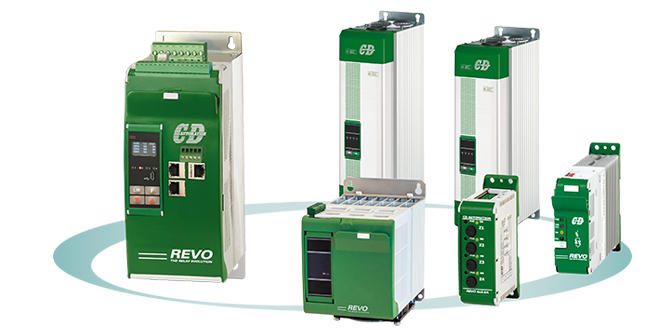
REVO Multi-Channel Units: advanced load management
The multi-channel units in the REVO range enable distributed management of electrical loads, helping to reduce costs, lead times and space requirements compared with traditional solutions based on separate components.
As well as improving plant efficiency, REVO systems optimise the heating process, reducing downtime and enhancing the stability of the production process.
One of the main objectives of the REVO platform is to improve power quality. The control algorithm distributes the required power across the various zones whilst keeping the line current as stable and balanced as possible.
This approach makes it possible to:
- reduce disturbances on the power supply line
- limit cable heating
- reduce power losses.
Phenomena such as flicker and harmonics, typically caused by the unsynchronised connection of loads, are reduced thanks to advanced control strategies.
The REVO POWER NETWORK system, together with ynamic Burst Firing technology, optimises the connection of electrical loads, helping to maintain a power factor close to 1 and to reduce energy penalties and disturbances on the grid.
REVO PN and REVO PC

REVO PN Power network
REVO PN is a compact and flexible solution, based on synchronised switching and a robust SCR architecture, designed to control complex loads, such as IR lamps with high current peaks.
Key features:
- control of heating elements up to 480V
- distributed architecture with installation in compact control cabinets integrated into the plant
- ideal for IR lamps in PET production, extrusion, co-extrusion and multi-zone furnace processes
- space-saving solution with modules ranging from 4 to 24 zones per fieldbus node, up to 25A per channel
- optional integrated I/O and temperature control modules
- compatibility with TIA Portal and Rockwell PLCs
- communication protocols: Profinet, Profibus, EtherNet/IP and Modbus TCP (depending on configuration).
REVO PC Power controller
REVO PC is a flexible solution featuring a separate control architecture for synchronisation and power management.
The control logic is based on REVO PN technology, whilst the power channels are managed by units from the REVO S 1PH or REVO Sx range.
Key features:
- control for heating elements up to 480V, 600V or 690V
- rated currents from 3A up to 800A
- single-phase and three-phase configurations complete with ultra-fast fuses
- ideal for IR lamps, extruders, plastic injection moulding, elastomers and multi-zone industrial furnaces
- 8 to 24-channel modules per fieldbus node
- dedicated current sensor for each solid-state relay for high measurement accuracy
- optional I/O and temperature control modules
- integration with TIA Portal and Rockwell PLCs
- protocols: Profinet, Profibus, EtherNet/IP and Modbus TCP.
Conclusions
The growing integration of renewable energy into modern electricity systems makes energy storage and smart load management fundamental to ensuring the stability, continuity and quality of the electricity supply.
In this context, the efficiency of power control systems becomes a key factor in optimising the use of available energy and reducing losses throughout the entire energy chain.
Solutions based on power electronics and advanced control architectures, such as those developed by CD Automation, support the evolution towards more flexible, high-performance systems that are better suited to the needs of modern energy and industrial infrastructures.
Do you work in the renewable energy sector and would you like to find out more about CD Automation’s solutions for electrical power control? Get in touch: our technical team is on hand to help you choose the solution best suited to your application