Infrared lamps:
In the field of industrial heating, infrared lamps play a crucial role. CD Automation, a leader in the automation sector, offers state-of-the-art solutions to optimise the use of these lamps. Our thyristor units for handling infrared emitters are designed to ensure precise and reliable power control, essential for a wide range of applications.
- Read more
By using our power controllers, companies can not only improve process efficiency, but also reduce operating costs and environmental impact. CD Automation’s solutions for infrared lamps offer unparalleled power management, ensuring optimal performance and longer lamp life. Rely on CD Automation for advanced and sustainable management of your infrared lamps.
Infrared lamps: select your load connection
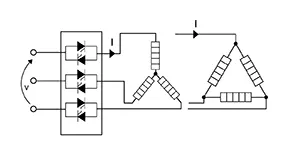
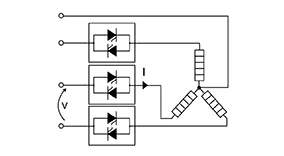
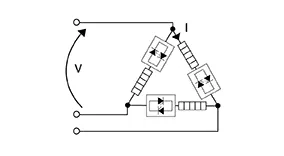
To get the most out of infrared lamps, choosing the right connection is crucial. CD Automation guides you in making the ideal selection, ensuring optimal performance of your machinery and reliability over time.

Medium- and long-wave infrared lamps

Medium-wave and long-wave IR emitters behave as normal resistors. If medium waves are used at a voltage value below the nominal value, they are treated as if they were short-wave loads.
Short-wave infrared lamps
With short-wave IR lamps, and in particular ultra-short-wave IR lamps, special care must be taken when choosing the junction used inside the thyristor unit. Indeed, when switched on, such lamps cause current peaks of 16 times the nominal current
Infrared Short Wave loads can be driven with different types of Firing: Single Cycle, Burst Firing and Phase Angle with Current Limit.
Learn more about CD Automation’s solutions for managing infrared emitters
In the area of industrial applications using infrared lamps, CD Automation offers a number of specific solutions to suit different IR emitters configurations. Understanding these configurations, together with the features of product families such as REVO PC, REVO S, REVO PN, REVO C, REVEX and REVO TH, highlights the company’s customised and technologically advanced approach.
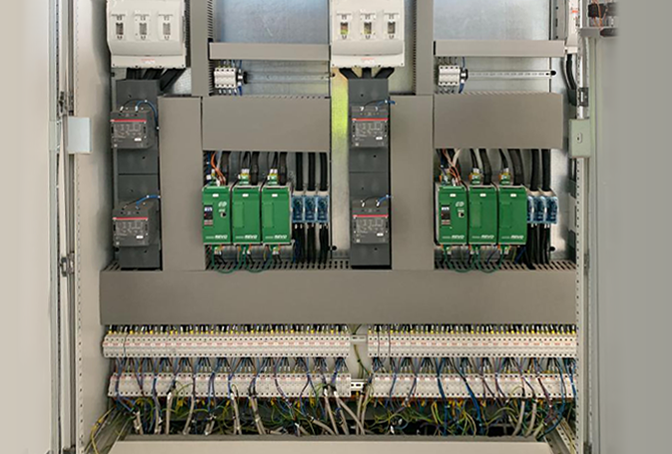
For IRSW 1PH (single phase) lamps, products such as REVO S and REVEX are particularly suitable. These devices offer precise power control, which is essential for the optimal operation of single-phase short-wave infrared lamps, ensuring even and efficient heating.
In the case of IRSW lamps in Delta/Star configuration without Neutral, power controllers such as REVO C and REVEX PA become indispensable tools. These systems are designed to effectively manage IR lamps in complex configurations, providing reliable and precise control of heating.
For short-wave IR lamps Star + Neutral configuration, the products of the REVEX family are just some of the proposals available. These controllers can precisely manage IR lamps in this specific configuration, ensuring the best performance and reliability over time.
Finally, for short-wave IR lamps in Open Delta configuration, systems such as REVO C and REVEX single-phase are particularly effective. These devices can handle various loads and adapt to different configurations, ensuring optimal control of IR lamps.
CD Automation can supply a complete panel comprising thyristor unit and temperature or humidity controller with automatic/manual control. The temperature can be measured with a thermocouple or pyrometer; in addition, a speed input can be used as a setpoint for the power.
Infrared lamps: some of the main applications
Explore how CD Automation’s products enhance the use of IR lamps in a variety of industries, offering customised solutions to optimise efficiency and performance in diverse industrial applications.
Paint drying
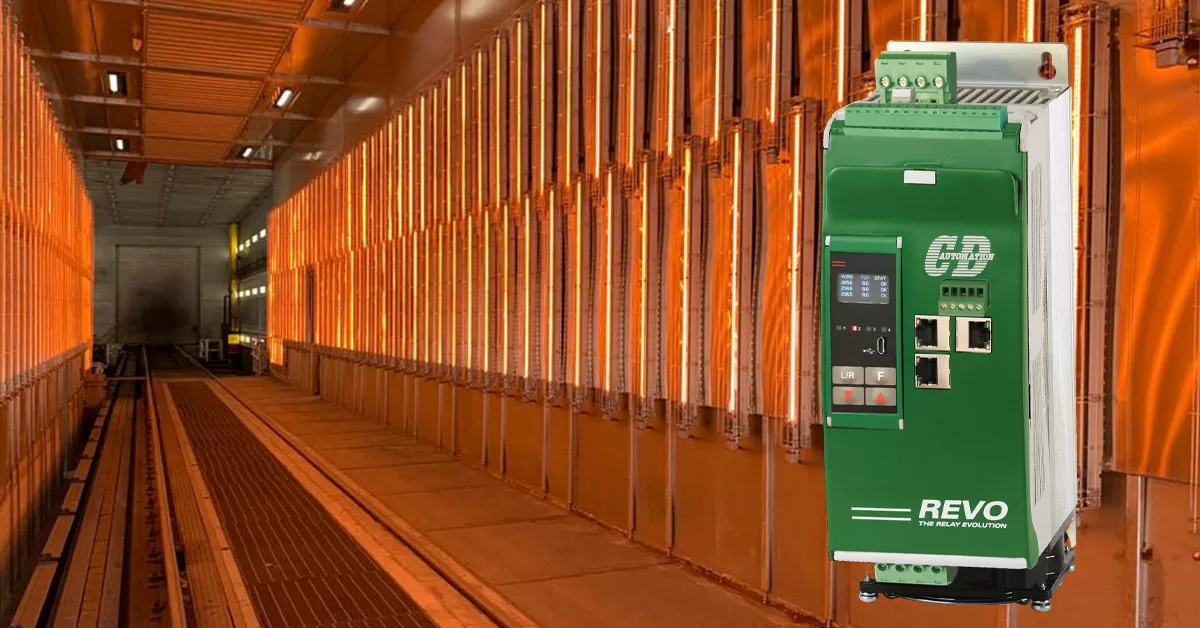
Infrared lamps are essential tools in the paint drying process, especially in industrial environments where speed and efficiency are crucial. In this context, CD Automation products emerge as ideal solutions. Thanks to their advanced control technology, CD Automation devices such as the REVO family of controllers, and in particular the REVO PN, allow the power emitted by infrared lamps to be precisely regulated. This precise control is crucial to ensure even and fast drying of the paint, avoiding problems such as overheating or poor curing. In addition, the efficient use of energy helps to reduce operating costs and environmental impact. With CD Automation’s products, operators can expect a paint drying process that is more controlled, efficient and adaptable to the specific needs of their industry.
Stretch Blow Moulding
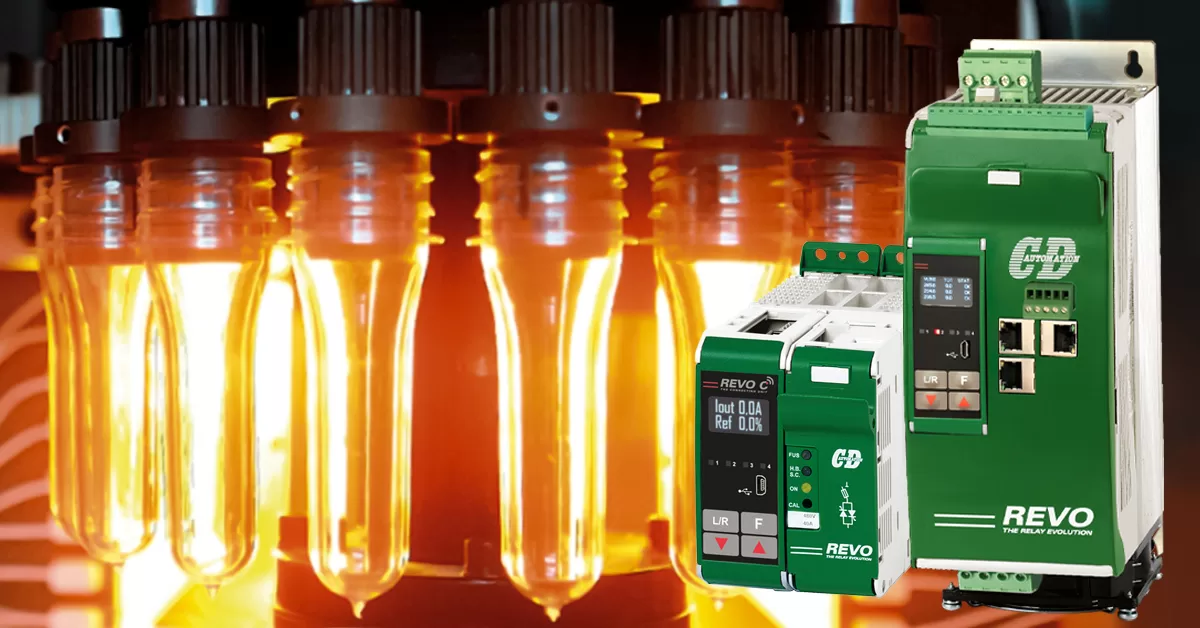
In the stretch-blow moulding process, an area where precision and efficiency are essential, the integration of CD Automation products can lead to a significant improvement in machine performance. Power controllers such as CD Automation’s REVO family offer advanced temperature and power management, key elements in ensuring quality in the stretch blowing process. This precise heat regulation allows the optimisation of the plastic moulding process, while reducing cycle times and increasing the quality of the finished product. Furthermore, the energy efficiency achieved with these control systems not only reduces operating costs, but also contributes to the sustainability of the entire production process. The use of CD Automation products in stretch blow-moulding is therefore a strategic investment to increase efficiency and quality in this industrial application.
Other industrial applications using infrared emitters
- Thermoforming
- IR Platens
- Packaging
- Composites
- Coatings
- Glass Forming
- Oil industry
- Aerospace/Aviation
- Automotive
- Construction
- Food
- Photovoltaics
- Printed Electronics
- Textiles
- Wood
Types of Infrared
- short wave infrared: peak current is approximately 7 times the nominal current. Special attention must be paid to thyristor sizing
- ultra short-wave infrared: peak current is approximately 16 times the nominal current. Special attention must be paid to thyristor sizing
- medium-wave infrared: peak current is approximately equal to the nominal current. No special consideration is required for peak current
- fast medium-wave infrared: these elements use a tungsten filament, like short-wave infrared emitters. Their peak current is lower, but the heating time is longer, resulting in a longer inrush current that places greater stress on the thyristors
- long-wave infrared: peak current is approximately equal to the nominal current. No special consideration is required for thyristor sizing
Low-voltage short-wave infrared applications
In the automotive industry and other special applications, short-wave infrared emitters (IRW) are sometimes supplied at a voltage significantly lower than their nominal voltage in order to modify the penetration of the infrared radiation.
Special care must be taken when sizing the thyristors for these applications. In addition to the normal precautions required for short-wave infrared emitters, extra attention is needed because operating at a lower supply voltage produces a lower current peak but a much longer inrush current, which can place considerable thermal stress on the thyristors.
For correct thyristor sizing, please contact CD Automation.
Additional technical information from the infrared emitter manufacturer will be required to determine the most suitable solution.
Frequently Asked Questions about SCR Power Controllers for Infrared Heating Applications
Why use an SCR Power Controller for infrared lamps?
Infrared lamps require precise power control to ensure uniform heating, product quality, and reduced energy consumption. An SCR (thyristor) controller allows continuous and accurate regulation of the power supplied to the lamps, improving process efficiency and increasing the lifetime of the heating elements.
What is the difference between short, medium, and long wave infrared lamps?
Short wave lamps reach high temperatures very quickly and are used in processes requiring an immediate thermal response. Medium and long wave lamps generally behave like traditional resistive loads and are suitable for processes requiring more uniform heating. The choice depends on the material being processed and the response time required by the production process.
Why do short wave infrared lamps require special attention in thyristor sizing?
Short wave and ultra-short wave infrared lamps generate high inrush current peaks at startup. In ultra-short wave lamps, the peak can reach up to 16 times the nominal current. For this reason, it is essential to correctly select and size the SCR controller to ensure reliability and long system lifetime.
Which firing mode is recommended for infrared lamps?
Infrared lamps can be controlled using:
- Phase Angle
- Burst Firing
- Single Cycle
- Zero Crossing
The choice depends on the lamp type, required response speed, and electrical system characteristics. Applications requiring very fast temperature regulation often use Phase Angle control.
Which CD Automation products are suitable for infrared lamp control?
CD Automation offers several SCR controller families for infrared emitter control:
- REVO S
- REVEX
- REVO C
- REVO PN
- REVO TH
The choice depends on lamp configuration, installed power, number of zones, and required level of integration with the automation system.
What is the best SCR controller for single-phase infrared lamps?
For single-phase IRSW (Infrared Short Wave) configurations, REVO S and REVEX are commonly used, as they provide precise power control and reliable handling of the high inrush currents typical of short wave infrared lamps.
How can multiple infrared lamp zones be controlled in a single system?
In industrial plants with multiple lamps or independent zones, multi-channel controllers such as REVO PN can be used. This solution reduces wiring, space requirements, and installation costs while improving energy management of the system.
Can infrared lamp temperature be controlled automatically?
Yes. CD Automation can provide complete systems consisting of SCR controllers and PID regulators, enabling automatic or manual control. Temperature can be measured using thermocouples or pyrometers and used as a feedback variable to automatically regulate lamp power.
In which industrial sectors are infrared lamps used?
Infrared lamps are used in many industrial sectors, including:
- paint drying
- plastic thermoforming
- stretch blow molding
- packaging
- glass industry
- food industry
- industrial printing
- printed electronics
- textile
- composites
- automotive
- photovoltaics
- aerospace
Thanks to their fast response, they are particularly suitable for processes requiring localized heating and precise temperature control.
How can the lifetime of industrial infrared lamps be increased?
Proper power management and control of current peaks are essential to extend the lifetime of IR lamps. Correctly sized SCR controllers help reduce electrical stress during start-up and operation, improving overall system reliability.
Is Phase Angle or Burst Firing better for infrared lamps?
There is no single answer. Phase Angle control provides extremely fast response and is often preferred for short wave lamps. Burst Firing reduces electrical noise on the grid and can be the ideal solution in many industrial applications. The choice depends on the lamp type and process requirements.